
Start with medical records, a dated record of reporting your injury, and pay statements showing your earnings. These documents help answer different questions, and you can gather them one step at a time. This 2026 guide groups the documents needed for an Illinois workers comp claim by what each record helps explain. Gather what you have, but do not delay reporting your injury while waiting for missing paperwork.
- The documents needed for an Illinois workers comp claim should establish the accident, medical treatment, work restrictions, and earnings.
- Medical records are the strongest starting point for documenting your injury; dated employer notice addresses a separate requirement.
- Gather existing records now. Do not delay reporting an injury while waiting for a complete file.
- Sobo & Sobo represents injured individuals pursuing Illinois claims on a no-win-no-pay basis.
Why This Matters
If you have never filed an Illinois workers’ compensation claim, start with four questions: What happened at work? What medical care do you need? Can you work? What did you earn before the injury? Different records help answer each question. You do not need to understand every benefit rule before asking for help.
Missing paperwork is a reason to request records, not a reason to postpone reporting your injury. Under section 6 of the Illinois Workers’ Compensation Act, accident notice generally must reach the employer within 45 days. Exceptions and special rules apply, including for certain conditions that develop over time.
Sobo & Sobo provides personal injury legal representation, including for injured individuals pursuing claims in Illinois. The firm works on a no-win-no-pay basis. Ask what representation would cover and how fees and case expenses are handled in the written agreement.
What Makes the Best Workers’ Comp Claim Documents?
Use these criteria to organize your 2026 claim file:
- Connection to work: The record explains what happened while you performed your job.
- Timing: A date shows when the accident, report, treatment, or missed work occurred.
- Medical detail: The document identifies symptoms, findings, treatment, or work restrictions.
- Earnings detail: The record separates wages, hours, and pay periods.
- Source clarity: You can identify who created the record and preserve the original.
These are evidence categories, not a universal filing checklist. You do not need every document in hand before reporting an accident or seeking treatment.
Illinois Workers’ Comp Documents at a Glance
| Rank | Document | Best for | Standout value | Key limitation |
|---|---|---|---|---|
| 1 | Medical records | Documenting the injury | Records clinical findings and treatment | A diagnosis alone does not establish a work connection |
| 2 | Dated employer notice | Showing you reported the accident | Preserves the report’s timing and contents | Delivery or receipt can still be disputed |
| 3 | Incident report | Recording the workplace event | Captures the employer’s account | Errors or omissions require separate clarification |
| 4 | Written work restrictions | Explaining work limitations | Identifies specific duties you cannot perform | Restrictions need updating when your condition changes |
| 5 | Payroll records | Supporting wage calculations | Shows earnings across pay periods | One pay stub rarely tells the whole story |
| 6 | Witness information | Corroborating events | Identifies people with firsthand knowledge | A witness might have seen only part of the event |
| 7 | Photos and video | Preserving physical conditions | Shows the scene or visible injury | An image does not explain everything outside its frame |
| 8 | Bills and expense records | Tracking treatment charges | Connects charges with services and dates | A bill does not establish medical necessity |
| 9 | Claim correspondence | Tracking decisions and disputes | Preserves explanations and requests | An insurer’s letter is not a Commission ruling |
1. Medical Records: Best for Documenting Your Injury
Medical records show what you reported, what the provider found, and what treatment followed. Request records of relevant emergency visits, office appointments, imaging tests, specialist assessments, and therapy sessions.
Describe the work event accurately when seeking care. If you notice an error in the history, ask the provider about its correction process; do not edit the record yourself.
Medical records pros:
- Document symptoms and examination findings.
- Establish a treatment timeline.
- Preserve the provider’s assessment and treatment plan.
Medical records cons:
- A diagnosis does not automatically establish that work caused it.
- Records from one provider can omit treatment elsewhere.
Best for: Showing the nature and course of your injury.
Your next step: save the medical records you have and list any providers whose records you still need.
2. Dated Employer Notice: Best for Showing You Reported the Accident
Preserve the email, text, letter, or reporting-system confirmation you used to notify your employer. Keep the message’s date, recipient, and full contents together.
Illinois law does not make written notice the only possible form of notice. A written record is useful because it preserves what you communicated; if you reported verbally, record who received the report and when.
Employer notice pros:
- Establishes the report’s contents.
- Identifies the recipient.
- Helps document timing.
Employer notice cons:
- A saved draft does not prove delivery.
- A vague message might leave the accident unclear.
Best for: Addressing questions about when and how you notified your employer.
Your next step: keep your original employer notice and any reply confirming it was received.
3. Incident Report: Best for Recording the Workplace Event
Request a copy of any incident report completed after the injury. Check the date, location, task, equipment involved, and description of what happened.
An incident report is separate from a formal claim filed with the Illinois Workers’ Compensation Commission. Completing your employer’s paperwork does not mean every filing requirement has been satisfied.
Incident report pros:
- Captures details close to the event.
- Identifies supervisors or other participants.
- Records the employer’s initial account.
Incident report cons:
- The report can contain another person’s assumptions.
- Missing details can create an incomplete picture.
If the report is inaccurate, preserve the original and provide a dated factual correction separately.
Best for: Establishing the circumstances of the workplace accident.
Your next step: request the incident report and keep any factual corrections with the original.
4. Written Work Restrictions: Best for Explaining Your Limitations
Ask your treating provider to document restrictions and their effective dates. Useful restrictions explain functional limits, such as lifting, standing, reaching, driving, or using an injured hand, when medically appropriate.
Keep any written job offer or modified-duty description alongside the restrictions. That pairing helps identify whether the offered duties match the provider’s instructions.
Work restrictions pros:
- Explain specific physical limitations.
- Document changes in your ability to work.
- Provide a basis for discussing modified duties.
Work restrictions cons:
- An outdated note might not reflect your current condition.
- Vague instructions leave room for disagreement.
Best for: Documenting what work you can perform during recovery.
Your next step: keep each work-restriction note so changes in what you can safely do are documented.
5. Payroll Records: Best for Supporting Wage Calculations
Gather pay stubs, wage statements, and records showing your hours and earnings before the injury. Include information about overtime, irregular schedules, or other employment for your attorney to evaluate.
Illinois benefit calculations use statutory wage rules. Your take-home pay is not necessarily the wage amount used to calculate workers’ compensation benefits.
Payroll records pros:
- Show earnings across pay periods.
- Separate hours worked from different types of pay.
- Help identify gaps in an employer’s wage information.
Payroll records cons:
- One pay stub may not reflect your usual earnings.
- Tax summaries do not explain every pay-period detail.
For your 2026 file, preserve original statements rather than relying only on a handwritten total.
Best for: Evaluating the earnings information behind benefit calculations.
Your next step: gather your wage history and ask which pay periods are needed for the benefit calculation.
6. Witness Information: Best for Corroborating What Happened
Save witnesses’ names, contact information, and a brief description of what each person observed. Separate someone who saw the accident from someone who only heard about it afterward.
A witness can also have relevant knowledge about your immediate symptoms or your report to a supervisor. Do not ask anyone to adopt wording or describe events they did not see.
Witness information pros:
- Identifies firsthand sources.
- Helps reconstruct the sequence of events.
- Keeps contact details available if a coworker changes jobs or becomes difficult to reach.
Witness information cons:
- Memory can change over time.
- A witness might know only one part of the story.
Best for: Supporting disputed facts through another person’s observations.
Your next step: save witness names, contact details, and their original messages without changing their wording.
7. Photos and Video: Best for Preserving Physical Conditions
Preserve existing images of the scene, equipment, visible injuries, and relevant conditions. Keep original files when possible, including their available date information.
If workplace cameras recorded the area, identify the location and approximate time for your attorney promptly. Do not assume a recording will remain available indefinitely, and never enter an unsafe or restricted area to obtain evidence.
Photos and video pros:
- Preserve visual details.
- Document conditions that later change.
- Supplement written descriptions.
Photos and video cons:
- The frame can exclude important context.
- An image alone does not establish medical causation.
Best for: Showing physical conditions connected to the accident.
Your next step: keep original images unchanged and use separate copies if you need to add notes.
8. Bills and Expense Records: Best for Tracking Treatment Charges
Keep itemized medical bills, pharmacy receipts, insurance explanations of benefits, and related collection notices. Match each document to the provider and service date.
These records help distinguish a treatment charge from a payment, adjustment, or outstanding balance. Keep other injury-related receipts for legal review without assuming every expense qualifies for reimbursement.
Bills and expense records pros:
- Identify providers and service dates.
- Track disputed or unpaid charges.
- Preserve proof of payments you made.
Bills and expense records cons:
- A charge does not prove treatment was necessary.
- An explanation of benefits is not the same as a bill.
Best for: Organizing the financial records associated with treatment.
Your next step: file itemized bills and payment confirmations together so charges and payments are easy to compare.
9. Claim Correspondence: Best for Tracking Decisions and Disputes
Save communications from the employer, claims administrator, insurer, attorneys, and Illinois Workers’ Compensation Commission. Include claim identifiers, benefit explanations, denial letters, and requests for information.
Keep any filed Application for Adjustment of Claim and its filing confirmation separately from an insurer’s claim-opening notice. Those documents serve different purposes.
Claim correspondence pros:
- Preserves stated reasons for decisions.
- Tracks requests and responses.
- Identifies the people handling the matter.
Claim correspondence cons:
- A claim number does not establish acceptance.
- An insurer’s position is not a Commission decision.
Best for: Following the claim’s administrative history.
Your next step: save complete messages and attachments, and keep proof of any claim filing.
How This Checklist Is Ranked
Medical records rank first because they document the injury and treatment. Notice and incident records address reporting and accident circumstances; the remaining categories answer narrower questions about work capacity, wages, corroboration, charges, and disputes.
The order reflects the questions each document helps answer, not a required filing sequence. A lower-ranked document can become the most important record when that issue is disputed.
Which Documents Should You Gather First?
Start with records you already have: employer notice, medical paperwork, work restrictions, and pay statements. Then request missing records without postponing necessary treatment or reporting.
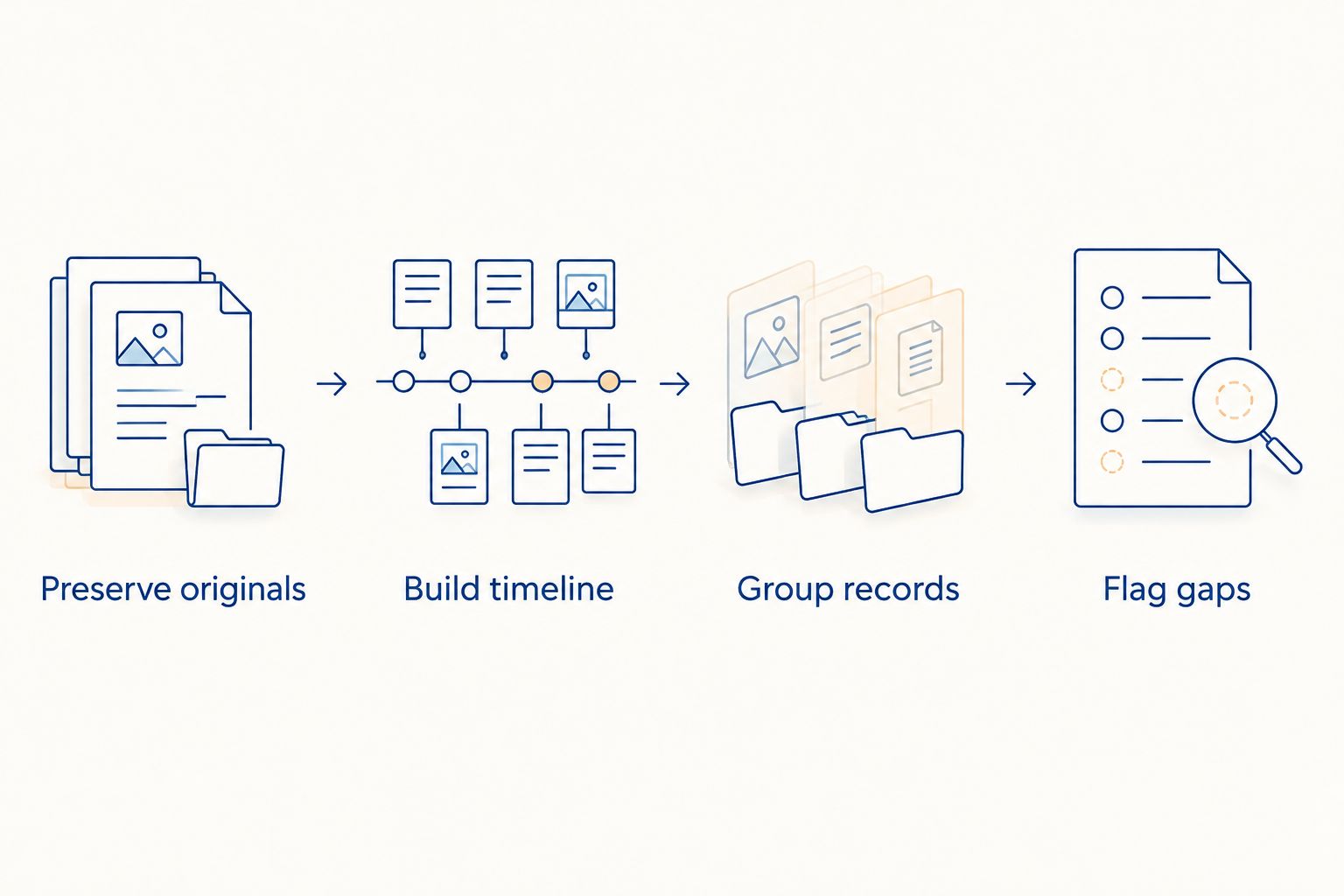
Use this sequence for your 2026 file:
- Preserve originals: Save messages, documents, and image files unchanged.
- Build a timeline: List the accident, notice, visits, and work-status changes.
- Group records: Separate medical, employer, wage, and claim paperwork.
- Flag gaps: Note missing documents and who holds them.
Sobo & Sobo provides legal representation for injured Illinois workers on a no-win-no-pay basis. Contact the firm to discuss your workplace injury, ask what representation would cover, and bring the records you already have. You do not need a complete binder to start the conversation.
Discuss Your Workplace Injury
Have questions about your Illinois workplace injury? Contact Sobo & Sobo to discuss your next steps and ask about no-win-no-pay representation.
FAQ
What documents do I need for an Illinois workers’ comp claim in 2026?
Gather medical records, employer notice, incident reports, work restrictions, payroll records, witness information, photos, bills, and claim correspondence. The records needed depend on the dispute. Do not wait to collect every item before reporting your injury.
Do I need every medical record before reporting my injury?
No. Report the injury promptly rather than waiting for a complete medical file. Under section 6 of the Illinois Workers’ Compensation Act, accident notice generally must reach the employer within 45 days, subject to exceptions and special rules.
Is an employer incident report the same as filing a workers’ comp claim?
No. An employer incident report is not the same as filing an Application for Adjustment of Claim with the Illinois Workers’ Compensation Commission. Preserve both documents when they exist.
How long do I have to file an Illinois workers’ compensation claim?
The general filing limit is 3 years after the accident or 2 years after the last payment of compensation, whichever is later, under section 6 of the Illinois Workers’ Compensation Act. Exceptions and rules about what constitutes compensation can affect the deadline, so have the dates reviewed promptly.
What if my employer will not give me the incident report?
Preserve your request and your own factual account of the accident. Keep the date, location, witnesses, and reporting details, and discuss obtaining the employer’s records with an attorney.
Are pay stubs enough to prove my lost wages?
Pay stubs are useful, but one stub does not necessarily establish the statutory wage calculation or your period of disability. Preserve wage history together with medical work restrictions and records of missed work.
Should I give an insurer my entire medical history?
Do not assume every medical record is relevant to the workplace injury. Review requests and medical authorizations with your attorney, and do not conceal relevant prior injuries or provide inaccurate information.
One Last Thing
The most useful document can be the message that proves when you reported the injury—not the thickest medical file. Before archiving your 2026 records, check that saved emails include attachments and that text-message copies show the sender, recipient, and date.
Keep a separate factual timeline, but do not rewrite original evidence to make the documents agree. Accurate records let you address inconsistencies directly.
This guide provides general Illinois workers’ compensation information, not legal advice about your claim.