
The most important steps to take after a workplace injury in New York are to get medical care, notify your employer, preserve evidence, and file your workers’ compensation claim. This 2026 checklist puts eight actions in order, with extra guidance for injuries involving contractors, unsafe equipment, or disputed benefits.
- The steps to take after a workplace injury in New York start with medical care and written employer notice.
- New York generally requires written employer notice within 30 days and a workers’ compensation claim within two years.
- Workers’ compensation and third-party personal injury claims follow different rules; investigate both when another party caused the injury.
- Sobo & Sobo represents injured individuals pursuing personal injury claims; consider the firm when investigating responsibility beyond your employer.
Why This Matters
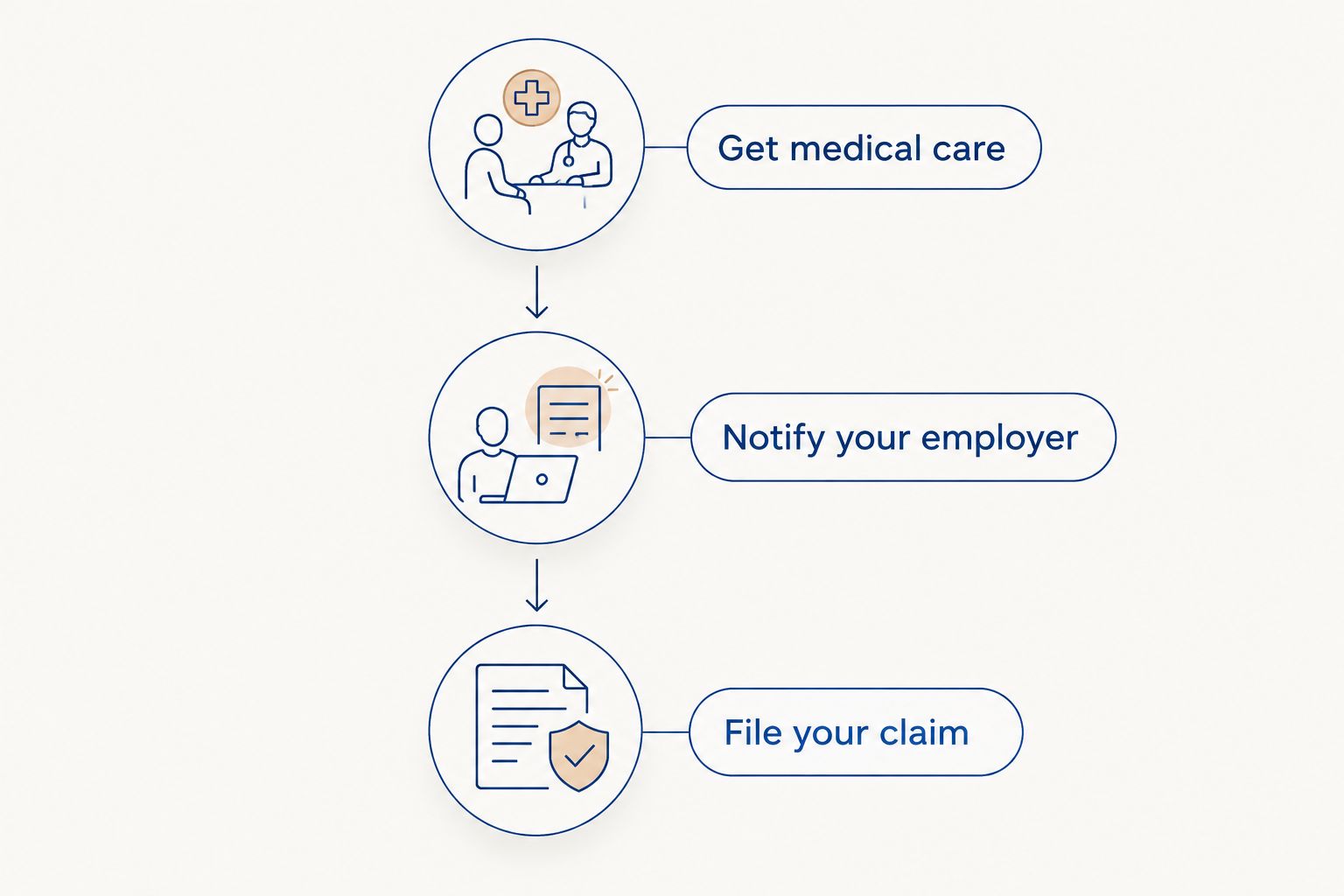
After a workplace injury, the paperwork can feel unfamiliar. Start with three separate tasks: get medical care, tell your employer, and file your workers’ compensation claim. Reporting the accident to your supervisor does not automatically file your workers’ compensation claim.
Sobo & Sobo provides personal injury representation for injured workers after New York workplace accidents. Contact Sobo & Sobo to discuss whether a person or company other than your employer could be responsible and ask about no-win-no-pay representation. Prioritize medical care, written notice to your employer, and filing your claim.
What Makes a Strong Workplace Injury Response?
Use these criteria to judge your next move in 2026:
- Medical urgency: Address immediate danger before paperwork or photographs.
- Deadline protection: Treat employer notice and claim filing as separate obligations.
- Evidence quality: Preserve original records, witness information, and accurate descriptions.
- Claim accuracy: Report symptoms and work restrictions honestly, without guessing.
- Recovery options: Check whether someone other than your employer bears responsibility.
- Decision control: Understand a denial, release, or settlement before responding.
Start with emergency treatment. When you are safe, you can gather evidence and notify your employer without waiting to finish one task before starting the other.
Eight Workplace Injury Steps at a Glance
| Priority | Action | Best for | Main benefit | Key limitation |
|---|---|---|---|---|
| 1 | Get medical care | Immediate injury or danger | Protects health and creates a treatment record | Treatment alone does not file a claim |
| 2 | Notify your employer | Creating timely employer notice | Documents when the employer learned about the injury | An internal report is not a Board claim |
| 3 | Arrange ongoing treatment | Continuing symptoms and work restrictions | Connects follow-up care with documented limitations | Ordinary nonemergency care generally requires an authorized provider |
| 4 | Preserve evidence | Establishing what happened | Protects records before conditions change | Evidence collection must not delay care |
| 5 | File your claim | Requesting workers’ compensation benefits | Starts your employee claim with the Board | Filing does not guarantee acceptance |
| 6 | Track benefits | Managing treatment, income loss, and paperwork | Makes missing payments and disputed care easier to identify | A personal log does not resolve a dispute |
| 7 | Investigate other parties | Accidents involving outside responsibility | Identifies possible personal injury claims | An injury alone does not establish liability |
| 8 | Review disputed decisions | Denials, hearings, and settlement proposals | Protects informed decisions and timely responses | Different decisions carry different procedures |
Your three main priorities are getting medical care, notifying your employer, and filing your claim. Complete each separately; none substitutes for the others.
1. Get Medical Care: Best for Immediate Injury or Danger
Move away from an active hazard if you can do so safely. Seek emergency treatment for a serious injury, and tell the treating provider that the injury happened at work. Describe what happened and which body parts hurt.
Do not stay at the scene to finish an incident report when you need urgent care. Explain any loss of consciousness, breathing problems, severe bleeding, or other urgent symptoms directly to emergency personnel.
Benefits:
- Addresses immediate medical needs.
- Creates an early record of symptoms and the reported accident.
- Gives you instructions for treatment and follow-up.
Limits:
- An emergency visit does not complete employer notice or claim filing.
- An initial assessment does not necessarily explain every continuing symptom.
Best for: Anyone with an immediate injury or unsafe working conditions.
Your next step: get urgent treatment first. Ask someone you trust to help with paperwork if you need support.
2. Notify Your Employer: Best for Documenting Your Injury Report
Give your employer written notice as soon as possible. Under New York Workers’ Compensation Law Section 18, the general deadline for notice of an accidental workplace injury is 30 days after the accident. Give notice promptly rather than relying on an exception.
Include the accident date, location, task, and injuries you know about. Keep a copy and a record of delivery. If your employer provides an incident form, read the completed version before signing and request a copy.
Benefits:
- Establishes a written account close to the event.
- Identifies who received your report and when.
- Helps separate your account from later recollections.
Limits:
- A verbal conversation is harder to document.
- An employer incident report does not replace your employee claim with the Board.
Best for: Workers who have not yet created a written notice record.
Your next step: notify your employer in writing and keep a copy, even if you already spoke with your supervisor.
3. Arrange Ongoing Treatment: Best for Continuing Symptoms
For ordinary nonemergency workers’ compensation treatment, use a provider authorized by the New York State Workers’ Compensation Board. Emergency treatment follows different rules. Check the Board’s provider guidance rather than assuming your usual doctor handles workers’ compensation cases.
Tell the provider what your job actually requires: lifting, climbing, driving, standing, or repetitive movement. Ask for clear written restrictions and follow-up instructions. Report new symptoms accurately rather than adding them yourself to an earlier medical record.
Benefits:
- Builds a record of treatment and recovery.
- Connects work restrictions to actual job duties.
- Helps document changes in your condition.
Limits:
- A medical appointment does not guarantee authorization for every proposed treatment.
- Missing follow-up care leaves gaps in the treatment record.
Best for: Workers whose symptoms or limitations continue after initial care.
Your next step: confirm your follow-up plan and ask your provider to explain any work restrictions.
4. Preserve Evidence: Best for Establishing What Happened
Save photographs, witness names, messages, incident reports, and relevant work instructions. Photograph the area or equipment only when doing so is safe and permitted. Keep original files rather than relying solely on edited screenshots.
Write down what happened while the details are fresh. Separate what you personally observed from what someone told you. If the accident may have been recorded, tell your lawyer where the footage is held so they can request that it be saved before it is overwritten.
Benefits:
- Records conditions that change after an accident.
- Preserves contact details for witnesses.
- Supports investigation of equipment, contractors, or property conditions.
Limits:
- Photographs do not establish every element of a legal claim.
- Entering restricted areas or handling dangerous equipment creates additional risks.
Best for: Accidents where the scene, equipment, or witness availability can change.
Your next step: save the evidence you have without returning to an unsafe area. A lawyer can help identify other records.
5. File Your Claim: Best for Requesting Workers’ Compensation
File your employee claim with the New York State Workers’ Compensation Board. The Board’s Employee Claim form is Form C-3. Reporting the accident to a manager or receiving an insurance claim number does not replace this step.
New York Workers’ Compensation Law Section 28 generally requires an accidental injury claim within two years after the accident. Occupational diseases have different timing rules. For a 2026 accident, verify the applicable deadline and file promptly rather than treating the outer limit as a target date.
Benefits:
- Places your employee claim before the Board.
- Records your description of the accident and injury.
- Creates a filing record you can retain.
Limits:
- Filing does not guarantee benefits or resolve disputed facts.
- Incorrect dates or incomplete descriptions create avoidable confusion.
Best for: Workers who have reported an injury but have not filed their employee claim.
Your next step: confirm that your Form C-3 employee claim has been filed and keep proof of submission.
6. Track Benefits: Best for Managing Income and Treatment Records
Keep a dated file of medical reports, work restrictions, missed shifts, wage records, insurer correspondence, and payments. Workers’ compensation generally provides medical benefits and wage-replacement benefits for qualifying work-related injuries, subject to eligibility rules.
If your employer offers different duties, compare the actual tasks with your medical restrictions. Ask for clarification when the assignment and restrictions conflict. Preserve the offer and your response instead of relying on an undocumented discussion.
Benefits:
- Makes payment gaps easier to identify.
- Connects missed work with medical documentation.
- Keeps treatment requests and insurer responses together.
Limits:
- A personal spreadsheet does not establish benefit eligibility.
- Disputed payments or treatment require action through the applicable process.
Best for: Workers managing ongoing care, missed work, or modified duties.
Your next step: keep track of payments and ask about a missing payment promptly, rather than waiting without an explanation.
7. Investigate Other Parties: Best for Identifying Who Else May Be Responsible
Workers’ compensation generally does not require proof that your employer acted negligently. A separate personal injury claim against another responsible party follows different rules and requires its own legal basis.
Depending on the facts, an investigation can involve a negligent outside driver, defective equipment, or responsibility at a construction site. Sobo & Sobo provides personal injury representation; ask whether your workplace accident supports a claim beyond workers’ compensation. If construction work caused the injury, prepare with these questions to ask a construction accident lawyer in New York.
Benefits:
- Examines responsibility outside the employment relationship.
- Identifies evidence needed for a separate claim.
- Helps you understand how compensation from separate claims could affect your recovery.
Limits:
- A workplace injury does not automatically create a third-party claim.
- Workers’ compensation liens and reimbursement rules can affect recovery.
Best for: Accidents involving outside drivers, contractors, property conditions, or equipment.
Your next step: ask whether your accident also supports a claim against another responsible party.
8. Review Disputed Decisions: Best for Denials and Settlements
Read every Board notice, insurer denial, hearing notice, and proposed agreement promptly. Identify the document, its filing date, and the response procedure. Do not assume all correspondence carries the same deadline.
Under Workers’ Compensation Law Section 23, an application for Board review of a Workers’ Compensation Law Judge’s decision generally must be filed within 30 days after the decision is filed. Other procedures differ. Before accepting a settlement, understand which benefits or claims the agreement resolves.
Benefits:
- Keeps deadlines tied to the correct document.
- Distinguishes a treatment dispute from a claim denial.
- Supports an informed settlement decision.
Limits:
- An informal complaint does not necessarily preserve review rights.
- A settlement can resolve rights you would otherwise retain.
Best for: Workers receiving an adverse decision or proposed release.
Your next step: ask for a clear explanation of the agreement and any response deadline before you sign.
How These Steps Are Prioritized
This 2026 checklist prioritizes health, deadlines, evidence, and informed decisions. It does not rank law firms or promise a claim result. The legal references are New York Workers’ Compensation Law Sections 18, 28, and 23, plus the Board’s Employee Claim and authorized-provider guidance.
Deadlines differ for accidental injuries, occupational diseases, and third-party lawsuits. Use the rule that applies to your facts, not a deadline borrowed from another type of case.
Which Action Should You Take First?
Get needed medical care first, then confirm written employer notice and your Board claim separately. If those actions are complete, organize your records and investigate unresolved responsibility or benefit disputes.
Sobo & Sobo represents injured individuals pursuing personal injury claims. If you are unsure which process applies, contact the firm to discuss your accident and ask what representation would cover. Confirm separately whether an agreement includes workers’ compensation proceedings, a personal injury lawsuit, or both.
FAQ
What should I do first after getting hurt at work in New York?
Get needed medical care first and move away from immediate danger if you can do so safely. Then give written employer notice, preserve evidence, and file your employee claim with the Workers’ Compensation Board.
How long do I have to tell my employer about a workplace accident?
New York generally requires written employer notice within 30 days after an accidental workplace injury. Give notice promptly and retain proof; exceptions are not a reason to wait.
Does my employer’s accident report count as my workers’ compensation claim?
No. An employer incident report does not replace your employee claim with the New York State Workers’ Compensation Board. Confirm that your Form C-3 has been filed and keep the filing record.
How long do I have to file a New York workers’ compensation claim in 2026?
For an accidental workplace injury, the general claim-filing deadline is two years after the accident under Workers’ Compensation Law Section 28. Occupational diseases have different timing rules, so identify the correct deadline for your injury.
Can I see my regular doctor after a workplace injury?
For ordinary nonemergency workers’ compensation care, your provider generally must be authorized by the New York State Workers’ Compensation Board. Emergency treatment follows different rules; check authorization before arranging ongoing care.
Can I sue someone other than my employer after a workplace accident?
Yes, when the facts support a separate claim against another responsible party. A lawyer must separately assess whether an outside driver, contractor, or equipment manufacturer is legally responsible. Workers’ compensation reimbursement rules can also affect your recovery.
What should I do if a workers’ compensation decision goes against me?
Read the decision immediately and identify the correct review procedure. An application for Board review of a Workers’ Compensation Law Judge’s decision generally must be filed within 30 days after the decision is filed; other procedures have different requirements.
One Last Thing
A claim number is not proof that every required filing is complete. Keep three separate records: your written employer notice, your employee claim filing, and your medical documentation. That simple separation makes it easier to spot an unfinished step before it becomes a dispute.
Related Guides