The best steps to take after a car accident in New York City start with safety: check for injuries, call for help, and move out of immediate danger when you can do so safely. This 2026 guide puts eight actions in order, from handling the scene to meeting reporting requirements and getting legal advice.
- The steps to take after a car accident in New York City begin with safety and emergency care.
- Document the collision, exchange information, and preserve evidence without putting yourself in the middle of traffic.
- New York requires certain driver accident reports within 10 days; police reporting does not replace your filing.
- Written notice for New York no-fault benefits is generally due within 30 days, subject to applicable exceptions.
- Sobo & Sobo provides car accident legal representation for injured people pursuing personal injury claims.
Why This Matters
After a crash, it is natural to have questions about injuries, repairs, and insurance paperwork. Take one task at a time: a police report records the collision, while notifying your insurer starts a separate process. Your no-fault application is another step for requesting eligible injury benefits.
Sobo & Sobo provides personal injury legal representation on a no-win-no-pay basis. Sobo & Sobo helps injured car accident victims pursue personal injury claims. If you are unsure where to begin, contact the firm to discuss your accident and ask what information to gather.
Use this 2026 checklist as a guide, but address urgent safety and medical needs before paperwork. Do not remain beside moving traffic to finish an insurance exchange or photograph a license plate.
What Makes a Useful Accident Checklist
The best checklist separates urgent actions from paperwork and explains the limits of each step. These are the criteria behind the order below:
- Safety first: Protect people before collecting evidence or discussing fault.
- Medical attention: Treat symptoms as a health issue, not just an insurance issue.
- Evidence quality: Record observations and preserve original files instead of guessing what happened.
- Reporting accuracy: Distinguish police notification, DMV reporting, and insurance notice.
- Claim protection: Avoid signing away rights before understanding the document.
Eight Steps at a Glance
The table summarizes what each step accomplishes. Follow emergency instructions and address your medical needs before collecting information.
| Step | Best for | Main benefit | Key limitation |
|---|---|---|---|
| 1. Get to safety | Preventing another collision | Reduces exposure to traffic and other hazards | Moving is not safe in every situation |
| 2. Call for help | Injuries and immediate hazards | Brings emergency responders when needed | A police response does not complete every reporting requirement |
| 3. Exchange information | Identifying drivers and insurance | Creates a record for follow-up | Information still needs verification |
| 4. Preserve evidence | Recording the scene | Captures conditions before they change | Evidence collection must not delay care |
| 5. Get medical attention | Evaluating crash-related symptoms | Supports treatment and a medical record | Medical records do not establish fault by themselves |
| 6. Complete required reporting | Meeting police and DMV duties | Addresses separate reporting obligations | Not every crash has the same requirements |
| 7. Notify insurance | Starting applicable claims | Opens the benefits and coverage process | Coverage depends on the policy and circumstances |
| 8. Review your legal position | Injuries, disputes, and settlement decisions | Helps identify rights and deadlines | Legal representation does not guarantee a recovery |
1. Get to Safety: Best for Preventing Another Collision
Stop after the collision. Check yourself and your passengers, turn on hazard lights if you can, and assess traffic before opening a door. A damaged vehicle can leave you exposed to passing cars, especially near intersections, bridges, tunnels, and highway ramps.
If the vehicle is operable and moving it is safe, get out of the travel lane. Do not attempt to drive a vehicle that appears unsafe, and do not move someone with a suspected serious injury unless an immediate danger requires it. Follow emergency instructions.
Best for: Everyone at the scene, before paperwork or photographs.
- Why it helps: Getting away from active traffic addresses the most immediate threat.
- Limit: The safest location depends on traffic, vehicle condition, and injuries; there is no universal instruction to stay inside or get out.
Do not stand between vehicles to inspect bumper damage. Leave belongings behind if retrieving them would expose you to danger.
Your next step: check everyone's safety first. Photographs and paperwork can wait when someone needs help.
2. Call for Help: Best for Injuries and Immediate Hazards
Call 911 when someone is injured, a person is trapped, there is a fire, or the collision creates an immediate danger. Give the dispatcher your location, the direction of travel, nearby intersections or landmarks, and what you can directly observe.
Report symptoms and uncertainty plainly. If you do not know whether someone is seriously hurt, describe their condition rather than attempting a diagnosis. Follow the dispatcher's instructions and avoid giving treatment beyond your training.
Best for: Crashes involving injuries or unsafe conditions.
- Why it helps: Accurate location and hazard details help responders understand the emergency.
- Limit: Calling police does not replace notifying an insurer or filing a required driver report.
When officers respond, ask how to obtain the report and record the incident information they provide. For a nonemergency collision, follow current NYPD reporting instructions rather than assuming an officer will attend.
Your next step: call for emergency help when injuries or danger require it, and let the dispatcher guide you.
3. Exchange Information: Best for Identifying Everyone Involved
Exchange names, addresses, driver’s license information, vehicle registration details, and insurance information with the other driver. Record the license plate number and vehicle description. If someone else owns the vehicle, include the owner's details from the registration.
Photograph documents only when doing so is safe and permitted by the person presenting them. Check that the images are readable before leaving. Avoid relying solely on a phone number or a verbal promise to handle the damage later.
Best for: Identifying the people involved and the insurance policies that may apply.
- Why it helps: Clear identifying information gives you and your insurer a starting point.
- Limit: An insurance card does not, by itself, confirm that a particular loss is covered.
Keep the conversation factual. Do not argue about fault, speculate about injuries, or agree to a private settlement at the roadside.
Your next step: record driver and insurance details safely. You do not need to settle questions about fault at the roadside.
4. Preserve Evidence: Best for Recording the Scene
Photograph the overall scene and closer details from a safe location. Include vehicle positions if you can capture them before vehicles move, but never delay a necessary safety move just to preserve a photograph.
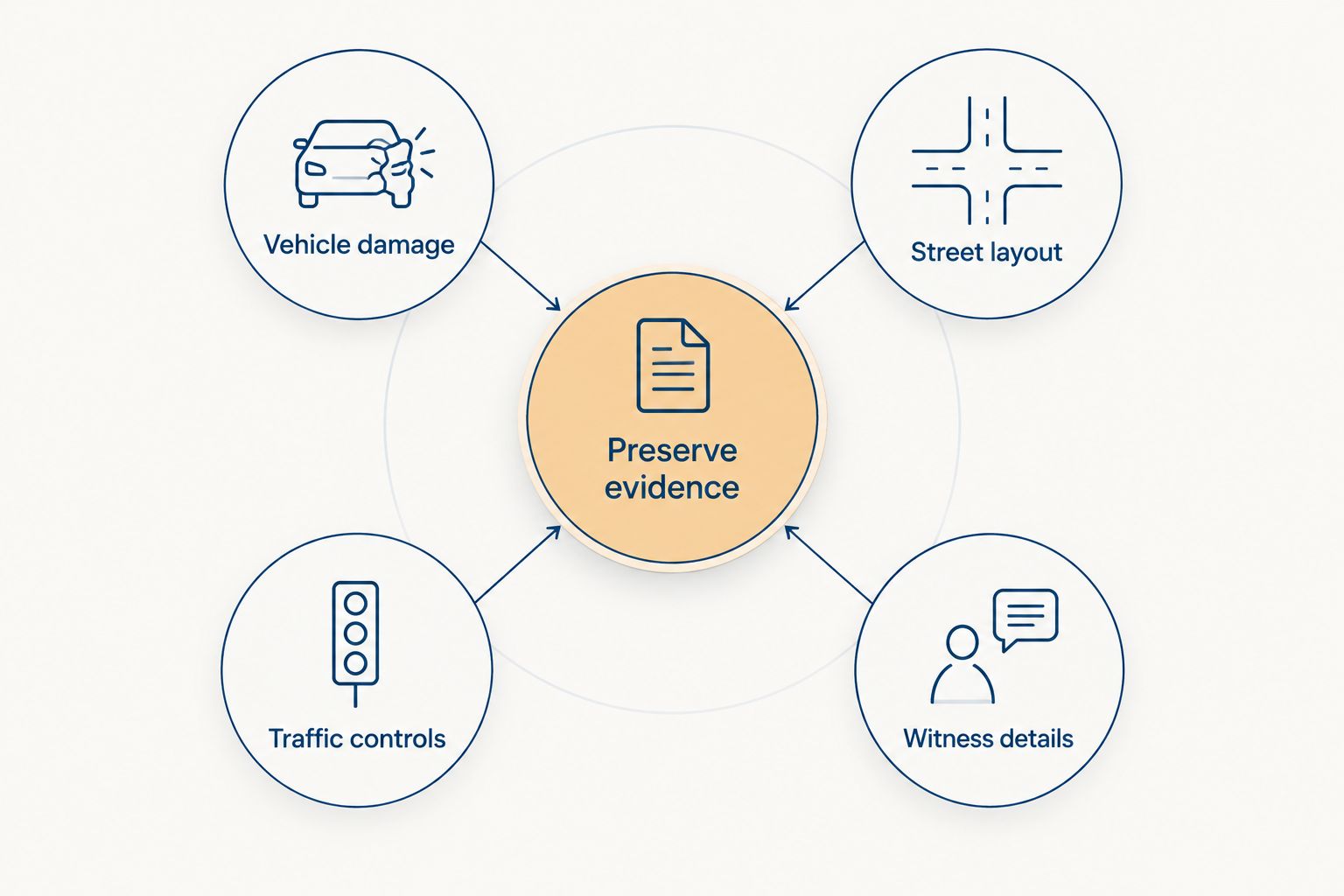
Organize your record around these categories:
- Vehicle damage: Photograph visible damage and relevant vehicle details.
- Street layout: Capture lanes, intersections, crosswalks, and the surrounding roadway.
- Traffic controls: Record signs, signals, and visible road markings.
- Witness details: Ask willing witnesses for their names and contact information.
Preserve original photos, videos, and dashcam files. Make a separate note of the time, location, weather, and what you remember; distinguish observations from assumptions.
Best for: Documenting facts that become harder to reconstruct after everyone leaves.
- Why it helps: Original records preserve details that memory alone does not.
- Limit: A photograph shows a particular view, not necessarily the entire collision.
Your next step: save original photographs and recordings, and ask for help collecting anything you cannot safely reach.
5. Get Medical Attention: Best for Evaluating Crash-Related Symptoms
Seek emergency care for urgent symptoms. Head injuries, breathing difficulty, severe pain, weakness, confusion, or significant bleeding require prompt medical assessment. Do not use this checklist to decide whether a serious symptom can wait.
Even without an obvious injury, arrange an evaluation when symptoms develop or you have concerns after the crash. Tell the clinician about the collision, your symptoms, and relevant medical history. Give accurate answers rather than exaggerating or minimizing what you feel.
Best for: Protecting your health and documenting necessary care.
- Why it helps: A medical evaluation helps your provider assess your symptoms, recommend treatment, and document the findings.
- Limit: Treatment records do not automatically prove that another driver was legally responsible.
Follow treatment instructions, keep appointment records, and report changes to your provider. Save discharge paperwork, prescriptions, bills, and receipts together instead of trying to reconstruct the record later.
Your next step: get care based on your symptoms and your provider's advice, not on an insurance decision.
6. Complete Required Reporting: Best for Meeting New York Duties
For a 2026 crash, separate police notification from your own DMV reporting obligation. New York DMV guidance requires a driver accident report, Form MV-104, within 10 days when someone is injured or killed, or when property damage to any one person exceeds $1,000.
An accident involving injury or death also requires immediate police notification under New York reporting rules. Other circumstances carry additional duties, including damage to an unattended vehicle or other property when the owner cannot be located. Follow the applicable instructions rather than treating every collision alike.
Best for: Addressing duties that remain after the roadside exchange.
- Why it helps: Filing the required driver report addresses a duty separate from police attendance.
- Limit: A police report does not replace your required MV-104 filing.
Use current New York DMV instructions, retain a copy, and keep proof of submission. If you do not know the cost of the damage, obtain an estimate promptly rather than assuming no report is required.
Your next step: check whether you must file a driver report, even if police attended. Keep a copy of what you submit.
7. Notify Insurance: Best for Starting the Benefits Process
Notify the relevant insurer promptly and follow the policy’s reporting instructions. Obtain a claim number, the representative’s contact information, and a written explanation of requested forms. Keep a dated record of submissions and conversations.
For New York no-fault benefits, written notice generally must be provided within 30 days after the accident, subject to applicable exceptions for a clear and reasonable justification. The New York Department of Financial Services describes this requirement in its no-fault consumer guidance. Do not assume that reporting vehicle damage also completes a no-fault application.
Best for: Starting the applicable injury-benefit and vehicle-damage processes.
- Why it helps: Timely notice gives the insurer an opportunity to process the claim.
- Limit: Eligibility, available benefits, and required cooperation depend on the circumstances and coverage.
For a 2026 claim, use the insurer’s current forms. Answer accurately and read any authorization before signing. If an insurer requests a recorded statement, ask what it will cover and clarify your obligations before participating.
Your next step: notify insurance promptly and ask which forms are needed for injury benefits and vehicle damage.
8. Review Your Legal Position: Best for Injuries and Disputes
Consider legal advice when you are injured, responsibility is disputed, several vehicles are involved, or you receive settlement documents. A collision involving a city vehicle or another public entity also calls for prompt attention because special notice requirements can apply.
Sobo & Sobo provides car accident legal representation for injured individuals pursuing personal injury claims. You do not need a perfectly organized file to ask for help. Bring the crash information, medical records, insurance correspondence, photographs, and documents you already have, and explain what is missing.
Best for: Understanding an injury claim before making a settlement decision.
- Why it helps: Legal advice can identify relevant parties, deadlines, and issues requiring investigation.
- Limit: Representation does not guarantee compensation, and an injury alone does not establish every element of a claim.
No-fault benefits and a claim against an at-fault party are different matters. No-fault benefits address eligible injury expenses under the applicable coverage; a separate claim considers another party's legal responsibility. New York's serious-injury rules limit certain personal injury recoveries, so a lawyer can explain which options fit your circumstances.
Your next step: contact Sobo & Sobo to discuss your injury claim before signing a release. By signing, you can give up your right to pursue the claims it covers. Ask for a plain-language explanation before agreeing.
How These Steps Are Ordered
This 2026 checklist ranks actions by urgency, not by the size of a potential claim. Safety and emergency care come first, evidence follows when safe, and reporting and insurance duties require separate attention. Legal review helps resolve questions the checklist cannot answer for an individual collision.
Which Step Should You Take First?
Start with the danger in front of you. If someone needs emergency care, call for help. If the immediate danger has passed, check that you have collected contact and insurance information, saved available evidence, and planned any medical care or reporting still needed.
Do not wait for a fault decision to address deadlines. For a 2026 accident, the 10-day DMV reporting rule and the general 30-day no-fault notice rule concern different tasks; completing one does not satisfy the other.
FAQ
What should I do first after a car accident in New York City?
Check for injuries and immediate danger first. Call 911 when emergency assistance is needed, and move out of active traffic only when you can do so safely.
Should I move my car after an accident in NYC?
Move an operable vehicle out of a travel lane when it is safe to do so. Do not drive a vehicle that appears unsafe or put yourself in traffic to inspect damage.
Do I have to file a New York DMV report if police came?
Yes, if the crash meets New York’s driver-reporting requirements. Police reporting does not replace your required MV-104 filing, which is due within 10 days for crashes involving injury, death, or property damage exceeding $1,000 to any one person.
How long do I have to notify no-fault insurance in New York?
Written notice for New York no-fault benefits generally must be provided within 30 days after the accident. Exceptions require a clear and reasonable justification, so submit notice promptly rather than relying on an exception.
What if I feel pain after leaving the accident scene?
Get medical attention for new or worsening symptoms and explain when the collision occurred. Seek emergency care for urgent symptoms rather than waiting for an insurance decision.
Should I accept the other driver’s settlement offer?
Do not accept a settlement without understanding what claims the agreement releases. Medical needs, coverage, and responsibility deserve review before you sign away rights.
When should I contact a car accident lawyer?
Contact a lawyer promptly when injuries, disputed responsibility, public entities, or settlement documents raise questions about your rights. Sobo & Sobo represents injured individuals pursuing personal injury claims on a no-win-no-pay basis.
One Last Thing
Preserve the original file, not just a screenshot. Keep original photographs, dashcam recordings, emails, and attachments in a backed-up folder, with a separate timeline of symptoms and correspondence. A tidy record helps you answer factual questions without relying on memory.
This guide provides general New York accident information, not legal advice for your specific circumstances.