
Start with medical evidence, records explaining your previous jobs, and the identity documents Social Security requests. You can begin organizing what you have without waiting for a perfect file. This 2026 guide ranks the documents needed to apply for Social Security Disability by their purpose, explains their limits, and shows you what to gather without delaying your application.
- The documents needed to apply for social security disability include medical evidence, work history, identity records, and earnings information.
- Medical records support your disability claim; work records explain the demands of your previous jobs.
- SSDI (Social Security Disability Insurance) and SSI (Supplemental Security Income) have different financial requirements.
- Do not delay filing because records are missing. Social Security can help obtain necessary information.
Why This Matters
If this is your first disability application, it helps to separate the paperwork into two parts. Medical evidence explains your condition and how it affects your ability to work; identity and earnings documents help Social Security check the other eligibility rules. A diagnosis matters, but examples of what you can and cannot do add important detail.
An accident claim is also separate from a disability application. Sobo & Sobo represents injured people pursuing personal injury claims; Social Security decides federal disability eligibility. A personal injury claim does not replace an application for disability benefits.
For adults, Social Security generally requires a condition that prevents substantial gainful activity—work that meets the agency's earnings and other work-activity criteria. The condition must have lasted, or be expected to last, at least 12 months or result in death. That duration rule does not mean you must wait 12 months before applying.
What Makes the Best Disability Application Documents?
Use these criteria to organize your 2026 application packet:
- Relevance: The record addresses your condition, work, identity, or financial eligibility.
- Specificity: It explains limitations rather than naming a diagnosis alone.
- Coverage: It helps establish when your limitations began and how they continued.
- Traceability: It identifies the provider, employer, or agency that supplied the information.
- Consistency: Dates and descriptions agree across your application and supporting records.
- Correct format: Identity documents and medical evidence follow different submission rules.
The categories below help you organize different parts of your application. The exact documents depend on whether you apply for Social Security Disability Insurance (SSDI), Supplemental Security Income (SSI), or both.
Documents at a Glance
| Rank and document category | Best for | Standout value | Key limitation |
|---|---|---|---|
| 1. Medical evidence | Supporting the medical disability decision | Documents findings, treatment, and functional limitations | A diagnosis alone does not establish disability |
| 2. Work-history records | Explaining previous job demands | Connects job duties to your reported limitations | A job title leaves important details out |
| 3. Identity and citizenship records | Confirming personal eligibility information | Supports age, identity, and citizenship or immigration status | Does not prove medical disability |
| 4. Earnings and tax records | Establishing earnings information | Helps Social Security review work and earnings | Financial records do not describe your limitations |
| 5. Provider and medication list | Helping Social Security locate evidence | Identifies treatment sources and relevant dates | A directory is not a medical record |
| 6. Completed disability forms | Presenting a consistent account | Organizes conditions, treatment, work, and authorizations | Forms cannot replace supporting evidence |
| 7. Other benefit and claim records | Reporting potentially relevant payments | Identifies workers’ compensation and other public disability benefits | Not every applicant has these records |
1. Medical Evidence: Best for Supporting Your Disability Claim
Medical evidence is the strongest starting point because it documents the condition behind your application. Gather records you already have from treating providers, hospitals, clinics, and relevant specialists. Useful records include examination findings, test results, treatment notes, and hospital discharge summaries.
Look for records describing how your condition affects everyday activities and work. Restrictions involving lifting, standing, concentration, attendance, or other work activities explain more than a diagnosis by itself.
Medical evidence pros:
- Documents findings and treatment over time.
- Helps establish the beginning and duration of limitations.
- Supports specific restrictions affecting work.
Medical evidence cons:
- Records written for treatment do not always describe work limitations.
- A single visit does not explain the full course of a condition.
Best for: Supporting the medical part of your application.
Your next step: gather relevant medical evidence you already have and identify missing records. You do not need a complete chart before applying.
2. Work-History Records: Best for Explaining Your Previous Jobs
Work-history information explains what your jobs actually required. Gather employment dates, employer details, job descriptions, and notes about your duties. Include physical demands, equipment used, hours worked, and supervisory responsibilities where the application asks for them.
Under the rules used in 2026, Social Security generally reviews the past 5 years when evaluating your past relevant work. Follow the dates requested on your current form rather than relying on an older checklist.
Work-history records pros:
- Distinguish your actual duties from a broad job title.
- Explain physical and mental demands.
- Help identify when your condition changed your work.
Work-history records cons:
- Employer job descriptions do not always match your actual duties.
- Estimates reconstructed from memory need careful checking.
Best for: Showing what your previous work required.
Your next step: explain a normal shift in your own words, including the tasks your condition now makes difficult.
3. Identity and Citizenship Records: Best for Confirming Eligibility Details
Social Security may request your birth certificate or other proof of birth and proof of U.S. citizenship or lawful immigration status. The documents requested depend on your circumstances and information the agency already has.
Follow Social Security’s document instructions carefully. For many identity and civil records, the agency requires originals or copies certified by the issuing office, rather than ordinary photocopies. Medical records and certain financial documents have different rules.
Identity records pros:
- Help resolve questions about your age and personal information.
- Support verification of your citizenship or immigration status.
- Reduce confusion caused by differences in how your name appears on documents.
Identity records cons:
- An ordinary photocopy is not always acceptable.
- These records do not establish disability or work limitations.
Best for: Confirming the personal information required for your application.
Your next step: check Social Security's submission instructions before sending original identity documents. Ask the agency if you are unsure.
4. Earnings and Tax Records: Best for Documenting Work Income
Gather the earnings documents Social Security requests, including relevant W-2 forms or self-employment tax returns. Current pay information also matters if you are still working or recently reduced your hours.
SSDI and SSI use different financial rules. SSDI considers insured status based on your covered work history, while SSI requires information about income and resources. An SSI application can therefore require bank-account and other financial records beyond employment paperwork.
Earnings records pros:
- Document employment or self-employment income.
- Help clarify recent changes in work.
- Support the review of nonmedical eligibility requirements.
Earnings records cons:
- Tax documents do not explain why your work changed.
- A prior return does not describe your current financial situation.
Best for: Answering earnings questions and identifying additional financial documentation.
Your next step: check whether you are applying for SSDI, SSI, or both, then follow the financial-document instructions for each program.
5. Provider and Medication List: Best for Locating Your Medical Evidence
Create a directory of the doctors, hospitals, clinics, and other treatment sources relevant to your condition. Include names, addresses, telephone numbers, treatment dates, and patient identification numbers when available.
Add your medications, the reason you take them, and the prescribing providers. This list helps Social Security request evidence; it does not substitute for the evidence itself. Include treatment sources even when you do not have copies of their records.
Provider-list pros:
- Gives Social Security a practical route to your records.
- Brings scattered treatment information together.
- Helps you complete medical-history questions consistently.
Provider-list cons:
- Incorrect contact details can complicate record requests.
- Medication names alone do not establish functional limitations.
Best for: Making your treatment history easy to identify and verify.
Your next step: use appointment records and prescription labels to build your provider and medication list, one source at a time.
6. Completed Disability Forms: Best for Presenting a Consistent Account
Your application and disability report bring the evidence together. The Adult Disability Report, Form SSA-3368, asks about medical conditions, treatment, and work. Social Security also uses Form SSA-827 to obtain authorization to request relevant information.
Use accurate dates and plain descriptions. If you do not know an exact date, follow the form’s instructions for estimates rather than inventing one. Review your answers against the records you already have.
Disability-form pros:
- Organizes information needed for the claim.
- Identifies treatment sources and work history.
- Provides authorizations needed to obtain evidence.
Disability-form cons:
- Incomplete answers leave important questions unresolved.
- Unsupported conclusions do not replace medical findings.
Best for: Explaining your condition, treatment, and work history clearly to Social Security.
Your next step: give accurate examples of the activities your condition limits. Plain descriptions are more useful than legal or medical jargon.
7. Other Benefit Records: Best for Reporting Related Payments
Keep award letters, settlement documents, and payment statements for workers’ compensation or other public disability benefits when applicable. Social Security asks about certain benefits because they can affect SSDI payments.
A personal injury settlement is not automatically the same as workers’ compensation. Different payment types receive different treatment, and SSI has separate income and resource rules. Identify what the payment represents instead of treating every injury-related payment alike.
Other-benefit records pros:
- Identify the source and type of payment.
- Support accurate answers about related benefits.
- Preserve the terms stated in an award or settlement.
Other-benefit records cons:
- Not every applicant receives another benefit.
- A payment document does not establish Social Security disability.
Best for: Applicants receiving workers’ compensation or other relevant payments.
Your next step: keep the actual award or settlement documents so Social Security can identify the type of payment correctly.
How These Documents Are Ranked
Medical evidence comes first because it documents your condition and limitations. The remaining categories cover your work history, eligibility information, earnings, treatment sources, forms, and other benefits. It is an organizing order, not an official Social Security ranking or a prediction of approval.
The requirements summarized here follow Social Security’s public disability application guidance, Adult Disability Starter Kit, and adult reporting forms applicable in 2026. Follow the document instructions for your application and circumstances.
How to Organize Your Application Packet
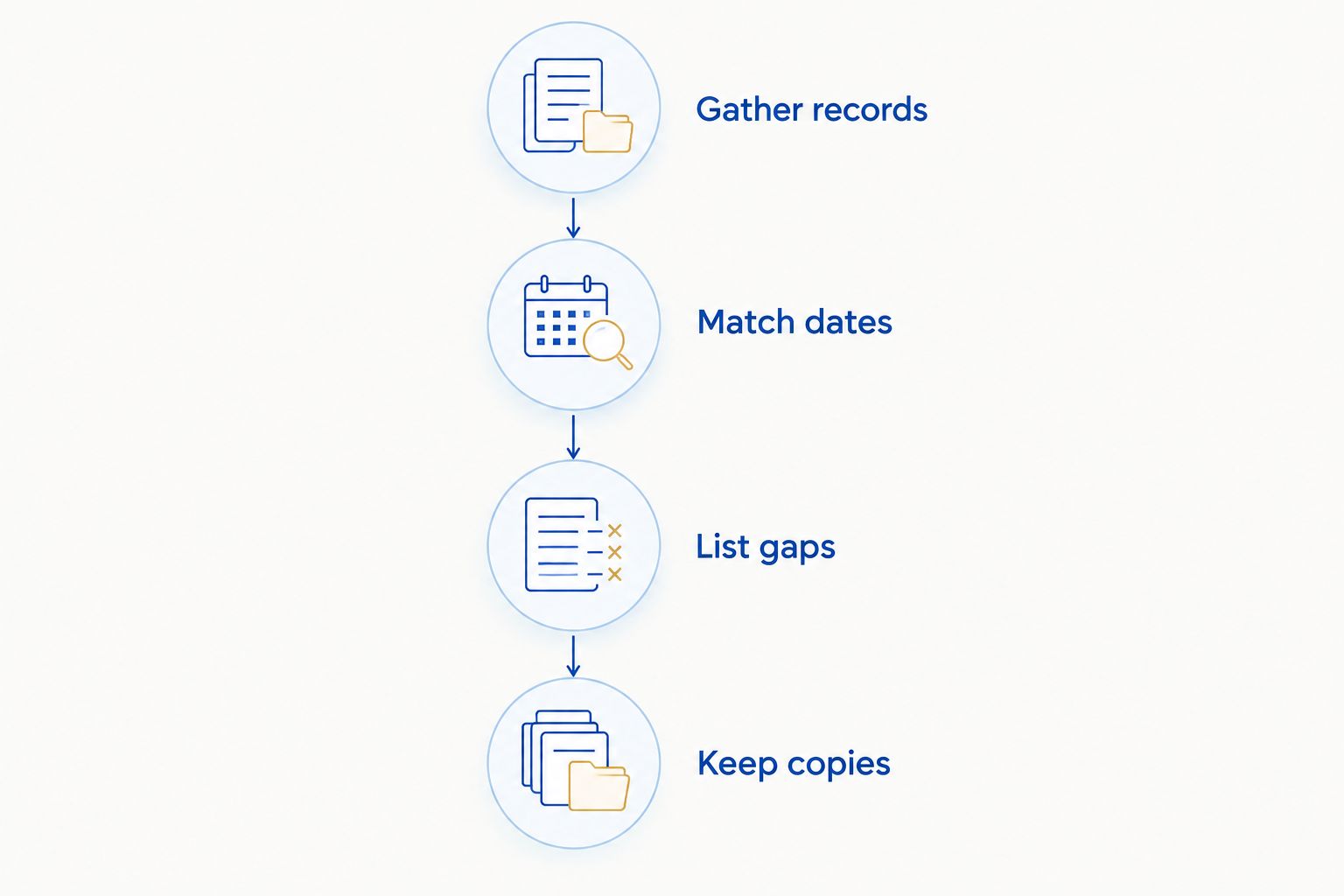
Use this sequence to turn a pile of paperwork into usable information:
- Gather records: Collect what you already have without waiting for every missing document.
- Match dates: Compare treatment dates, job changes, and your reported disability onset.
- List gaps: List any missing provider details, documents, or other information Social Security needs.
- Keep copies: Retain your submitted answers, documents, and agency correspondence.
A missing record and an inconsistent answer are different problems. Identify missing evidence honestly; correct factual mistakes before submitting your forms.
Which Documents Should You Prioritize?
Start with medical evidence and a provider list, then organize your work history and requested eligibility documents. If records are missing, tell Social Security which records you need and where the agency can request them. The agency’s disability application guidance specifically advises applicants not to delay applying because they lack documents.
If your condition followed an accident, you may also have questions about a separate personal injury claim. Contact Sobo & Sobo to discuss that injury claim and ask what representation would cover. Your Social Security disability application remains a separate process; confirm directly whether the firm can assist with it.
FAQ
What documents do I need to apply for Social Security Disability in 2026?
Gather medical evidence, work-history information, identity records, earnings documents, provider details, and the required application forms. Include other benefit records when applicable; SSI applicants also need information about income and resources.
Should I wait until I have every medical record before applying?
No. Social Security advises applicants not to delay filing because documents are missing. Identify your treatment sources and provide the records you already have.
Do I need to be out of work for 12 months before applying?
No. The condition must have lasted, or be expected to last, at least 12 months or result in death, but you do not have to wait that long to apply. Other medical and nonmedical eligibility requirements still apply.
How much work history does Social Security review?
Under the rules used in 2026, Social Security generally considers the past 5 years when evaluating past relevant work. Follow the exact period requested on your current application or work-history form.
Can I submit photocopies of all my documents?
No. Social Security generally requires originals or issuing-agency-certified copies for certain civil and identity documents, while it accepts photocopies of some other records. Check the instructions before mailing originals.
Are SSDI and SSI application documents the same?
No. The medical information overlaps, but the programs have different nonmedical requirements. SSI requires financial information about income and resources, while SSDI eligibility depends partly on covered work history.
Does a personal injury claim count as a disability application?
No. A personal injury claim and a Social Security disability application are separate matters. Sobo & Sobo represents injured individuals pursuing personal injury claims; a federal disability application must still be submitted through Social Security.
One Last Thing
Describe the activity, not just the symptom. Pain is a symptom. Explaining how it limits sitting, handling objects, or concentrating shows how it affects your ability to work. Give accurate examples, and make sure your forms distinguish your own account from restrictions documented by a provider.
Before submitting your 2026 application, compare your forms with your provider list and work history. Correct mismatched dates, retain copies, and respond to Social Security’s follow-up requests.
Related Guides
- Questions to ask a construction accident lawyer in New York
- Steps to take after a car accident in New York City